




Let’s right away put this slice of historical fiction on a par with the other great films about the Indo-Pak partition. In his maiden feature film, Chandraprakash Diwedi has created a work as timeless in its tensions and universal in appeal as M.S. Sathyu’s Garam Hawa and Tamas. Pinjar goes way beyond the pseudo-historicity and febrile flamboyance of Anil Sharma’s Gadar to look at the tragedy of a nation being torn into two. In searching out those areas of darkness that besieged a nation in damnation, Diwedi has remained true to Amrita Pritam’s original novel without turning cinema into a celebration of the literal and prosaic.
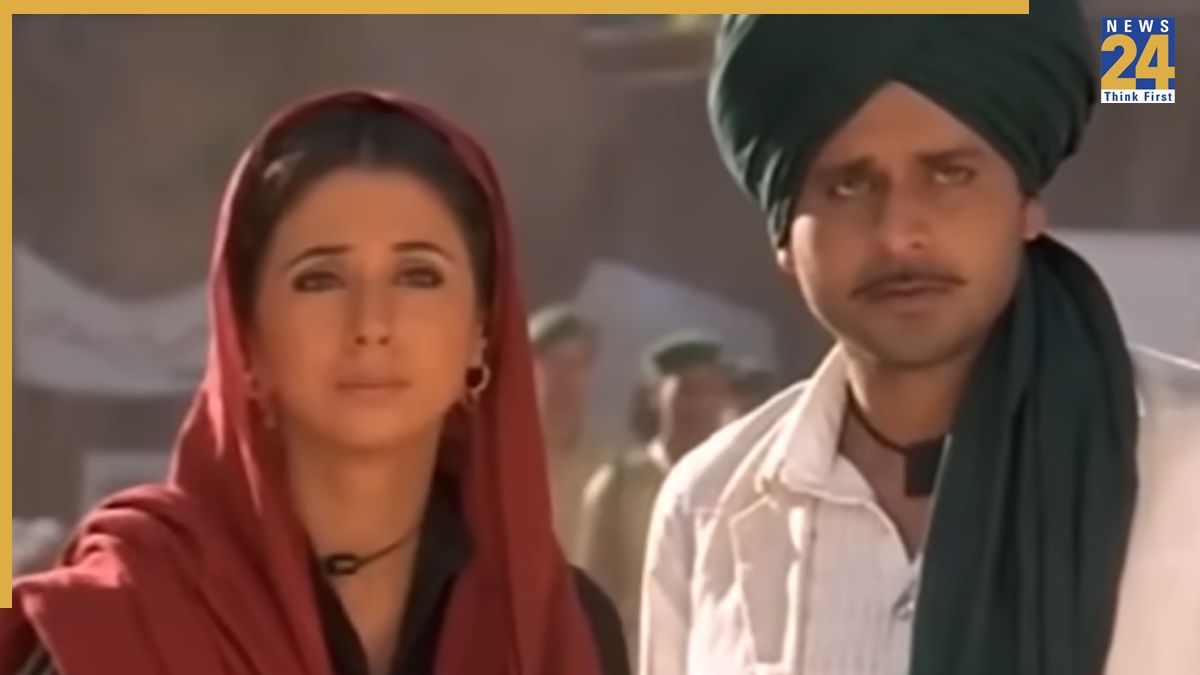
From Gulzar’s opening commentary to the stunning finale when the torn and traumatised protagonist Puru (Urmila Matondkar) decides to stay back with her abductor Rashid (Manoj Bajpai) in Pakistan even when offered the option of returning home to India, Pinjar is an enchanting tragedy that sweeps across an illimitable time and space to create a mesmeric movement of light and shade.
Indeed, one of the film’s many mega-virtues is its glistening technical polish. Santosh Thundiyil’s cinematography and Munish Sappel’s art design are exquisitely underscored. Whether in adapting the brilliantly evocative novel or in giving visual life to the myriad characters who suffer as they grow with the trauma of the Partition, the director doesn’t ever loses grip over his characters’ destiny.
Every actor is cast in a malleable mould. They remain putty in the hands of the double destiny that controls them. If Diwedi unleashes a fury of karmic upheavals in his characters’ lives, he also underpins those upheavals with a subtle control that works like the strings of a kite.
Every performer flies high. Urmila just slips into Puru’s part. At times, she’s let down by her makeup person, who slaps it on too thick. But she never grows untrue to the character. In portraying a woman who goes through a graphic cyclone, Urmila adds shades and nuances to the character that perhaps the authoress Amrita Pritam herself would‘ve missed. Once again, Urmila proves herself to be one of the most accomplished actresses of her generation.
Manoj Bajpayee, in the central male role of the conscience-stricken, almost-penitent abductor, takes you by surprise. It’s a vital and decisive role in his career, and one that he plays with a restraint that sets the screen aflame. This is Bajpai’s most accomplished performance since Satya. The other watchable male performance is by Priyanshu Chatterjee. As Puru’s diffident brother who refuses to forget his abducted sister, he swathes his character in an endearing warmth. Sanjay Suri once again makes you wonder why he’s apportioned such a meagre part of the movie cake.
Every actor breathes a fire of conviction into this passionately recounted tale. Pinjar is a film which glows with an inner conviction. From Uttam Singh’s carefully conceived musical pieces and songs that set the pace and tone for the pulsating periodicity, to the hauntingly credible locations capturing the bleak forbidding tempo of a tumultuous time, Pinjar simply overpowers your emotions and easily makes you overlook its minor flaws (e.g the length and the rather banal comic portions towards the end when Puru goes door to door searching for her fiancee’s abducted sister).
It’s the deep-seated poignancy of the original material which makes us look at the film with a profound affection. Sequences such as the one when Puru runs away from captivity only to be rejected by her parents (played with surprising spatial suffocation by Kulbhushan Kharbanda and Lilette Dubey), or that long lyrical passage of narration when Puru visits the village of her intended husband, are masterfully manoeuvred from literature to celluloid.
As the narrative grew, Diwedi focuses progressively on the human tragedy rather than the political holocaust. Wisely, the scenes of mob violence are restricted. We see the entire trauma through the eyes of Puru, and later Rashid, who we realise is as much a casualty of history’s cruel mysteries as the woman whom he unthinkingly kidnapped.
There is an enchanting love story embedded at the heart of this film about the politics of communal violence. Bajpai and Matondkar live that love story with every pore of their being.