
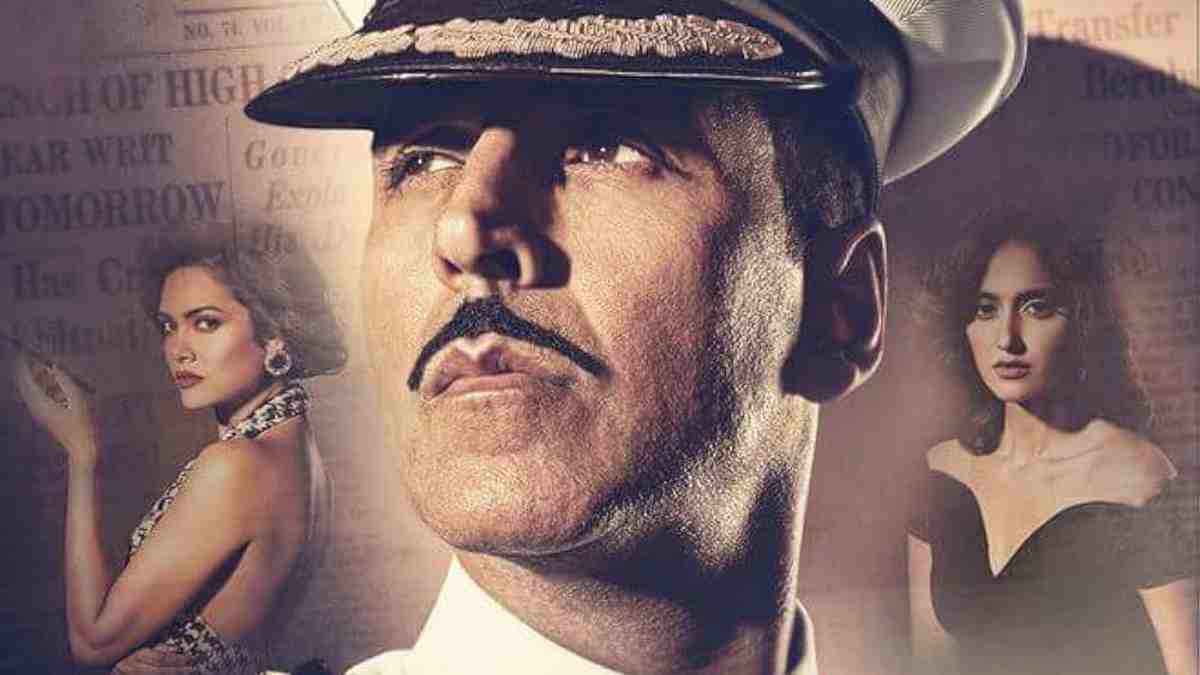


A picture-perfect naval officer, highly decorated, principled, patriotic and deeply in love with his wife, comes ashore quicker than expected and catches his wife cheating with his best friend. Since the husband is played by the remarkably evolved Akshay Kumar, we are mercifully spared the hysterical aftermath of an inherently melodramatic crime of passion that shook and stirred Mumbai’s beau monde in the year 1959.
That was the celebrated Nanawati case, known to change the way we look at the laws regarding crimes of passion. Rustom plucks the core of the crime, unplugs the theme of infidelity from its original context and plays deviously around with the facts to create a semi-fiction ‘what-if’ scenario where the characters hurl towards what the film’s writers would like to think of as an unexpectedly shocking ending.
It’s like watching a true-life crime story from Shyam Benegal done in Walt Disney studios. The passion and drama FEELS real, thanks to a solid sincere central performance. But the manner in which the story unfolds suggests that no harm can come to this world of fragile, blemished but unbreakable Utopia.
Director Tinu Suresh Desai, who last visited London in the year 1920 in London 1920, takes to Mumbai in 1959 with a ferocious fulsomeness. There is a cardboard voluptuousness about the sets, including the courtroom where most of the drama in the second half unfolds. The accents are exaggerated and excitable, and the makeup is lush and accented, ripe and crimson, as though to highlight the theme’s deep-rooted affinity to Hitchcock and Brian De Palma’s film noire.
Tinu tackles the tender and powerful moments in the plot with all the skill at his disposal. Many of the potentially powerful moments suffer from the want of respite. The pace is breathy and anxious. The idea is to grab the restless audiences’ attention without inundating them in periodicity. The plot is therefore pulled forward with an urgent tug where we are led to believe that there is more to this crime against infidelity than meets the eye.
By the time the shock end bounces into the stylized courtroom (more akin to B. R. Chopra’s Kanoon than Subhash Kapoor’s Jolly LLB) we are not left with much room to absorb the enormity of the ‘revelation’.
The makers of Rustom were right. This is not the Nanawati case that shook Mumbai in 1959. The 1963 film Yeh Raaste Hain Pyar Ke was much closer in spirit to the real crime. And the bewitching Leela Naidu as the unfaithful wife… ummm… killed it. Ileana D’Cruz’s wife is distressfully apologetic and sniveling. Why must her infidelity be seen as an accidental slip and why she be the hand-wringing, lip-biting penitent wife who worships her husband for being such a pillar of strength during times of marital adversity?
If only the script had the guts to say that what we all know – that women with absentee husbands do stray from the marital fold – this film could have been a powerful voice for a spouseless wife’s sexual needs the way Aruna Raje’s Rihaee was so many years ago. Instead, in Rustom, Ileana D’Cruz is shrill and repentant like Reena Roy in Bezubaan after ‘photographer’ Naseeruddin Shah seduced and blackmailed her.
It is all the randy philanderer Arjan Bajwa’s fault, you see. Why oh why did he seduce the wife? Some of the supporting roles such as Bajwa’s philanderer, Esha Gupta as his vengeful sister, Pavan Malhotra as the investigating cop, and Kumud Mishra as Russy Karanjia-modelled tabloid editor throw forward interesting possibilities but remain shadowy figures meant to contour the heroic dimensions of the main protagonist.
Rustom is unmistakably a vehicle to showcase Akshay Kumar’s power to portray spiritual transparency during times of stressful betrayal and deception. He does so with a sincerity that is at times heartbreaking and at other times reassuring. After Airlift, this is one more performance from Akshay that proves he can hold the camera without making overt attempts to get our attention. Most of the second half of Rustom is a courtroom drama with Akshay fighting his own case. Indicative of the film’s battle ahead.
Director Tinu Desai spoke on Rustom. “Vipul K Rawal, who was the writer of my film, who had written the story, screen dialogues, he brought a script to me and when I read the script, I came to know that he had done a lot of research. When we decided that we are making this film, I read all the stories on all the platforms and all the stories related to this story, all the aspects, all the points, and we discussed it with Vipul. We added some points in the script, but this film was not completely based on the Nanavati case, it was inspired, this 80% film was fiction, so according to that, many things came in front of us which were very interesting and we had to include those things in the script. The film is only two and a quarter hours long. There are many restrictions as to what we should keep in the film and what we should not, what we should not keep in the film, so sometimes there used to be fights as to why we are removing this, we should keep this, this had happened in real life, many such things had happened in real life which we could not keep because we had a time limit that the script of the film should be of this length in this much and according to that we had a plan, a lot of research was done. And also, we did try to connect with Nanavatis. We also tried to connect with Nanavati’s son who lived in Bangkok, Vipul Bhai also did it but I think he had said that he does not want to talk about this, so we respected that thing, so we did a lot of research on the Parsi background, Parsi families, how do Parsi marriages happen, what kind of lifestyle do they have, how is the house, we had seen many Parsi houses, how is their interior, we had seen our houses, how is their interior. Priya Suhas was the production designer. We went to the docks with her on a mission to the Navy docks to see what kind of atmosphere exists in the docks, which we had to create, basically because you cannot shoot in the docks. So a lot of research was done regarding costumes, regarding the town, how Mumbai looked in those days, the courtroom, all those things. Yeah, we did a lot of research. When my research and the entire script was over and finalized, after that, all the things that I had referenced during that period, all the articles about Nanavati and the surroundings, the conspiracy, all the points of view that were related to the script, I shared all those things with Akshay Sir. His look… It was about Nanavati, what kind of things that go into the Navy’s documents, what are the protocol, Parsi background, families, marriage videos, I had shared all the things with the people around me like Akshay Sir’s manager is a Parsi, so we used to take inputs from everyone, so in this way all the things, we discussed very well, before the shoot, we did not have any confusion on set, nor was there any discussion once we started shooting.”
Historian Gyan Prakash, who has done comprehensive research on the Nanavati case, found Rustom ill-researched?
Desai defends his film. “We were making a film, we had taken the incident, and there were many things, which we wanted to keep, which had happened, which definitely Gyanji must have felt missing in the film. We also wanted to keep things, but we had our restrictions. Our story, the way we wanted to tell the story, we could not keep all those things in the film, and if Gyanji was disappointed, then I will say sorry for that, because I will try, that if I get to make a web series on Rustom, I will keep all those things in that web series, which I had researched, and keep all the things that we knew that we have to add, also keep Gyanji’s point of view in that web series. As a director, it was a very big film for me. My producers, Neeraj Pandey ji and Sheetal Bhatia ji, had given me a very big film, trusting me to do the needful. So, there was definitely a lot of pressure on me to deliver. It was a period drama. It was inspired by a big, well-known incident. All the big people were there. Akshay Sir, Ileana D’Souza, Esha Gupta, Kumud Mishra, Pavan Malhotra, Parmeet Sethi, Arjan Bajwa, Ishtiyak Khan… all the big actors were there. All the actors were very experienced. So, my experience with everyone was very good. I was very clear from the very first day about every character. So, one thing was very clear to me that there was no confusion about how Rustom would behave with his wife. How would Rustom behave in a courtroom, in a police station, or how would Rustom behave in front of senior navy officers? All those things were very important. I discussed all these things with Akshay Sir. He supported me in this regard by never letting me feel that I was making this first film. Sir, the director is never satisfied. But as you know, things are not always under a director’s control. Money is involved, and the point of view of many big people is attached to a film. A hundred things happen with a film, sometimes they happen according to you, sometimes they don’t happen according to you, so what? But this is part of the game, which I will have to face in every film. So it is better that, whatever is happening, you have to give your best to it. So every creative person, I think, keeps thinking about how to improve their work. If someone wants to make Rustom again, if a web series is made, then definitely, whatever flaws people feel are there, which I also feel somewhere are there, I’d definitely work on them. There should have been more detailing. There should have been more involvement in the storytelling. All those things, like Gyan Prakashji’s point of view and the research that he has done, I would definitely like to use all of that. I would like to include it in that web series.”
ALSO READ: Materialists; Strong Premise, Poor Execution