



One of Javed Akhtar’s lyrics—Halki halki mulaqatein thi—best describes the tenor, flavour, and mood of debutant director Rohan Sippy’s Kuch Na Kaho.
Young Sippy has his father Ramesh Sippy’s formidable reputation to live up to. Rohan doesn’t disappoint. There’s an intuitive integrity combined with a subtle ingenuity at work here. These qualities may not make themselves apparent to viewers all at once. But as the elegantly paced (hats off to editor Rajiv Gupta) and elegantly ‘faced’ (ditto art director Sharmishta Roy) tale unfolds, we’re driven far away from the clamour and glamour of the typical Bollywood glossy into a world where subtle gestures and unspoken feelings count for more than in-your-face techno-flashiness.
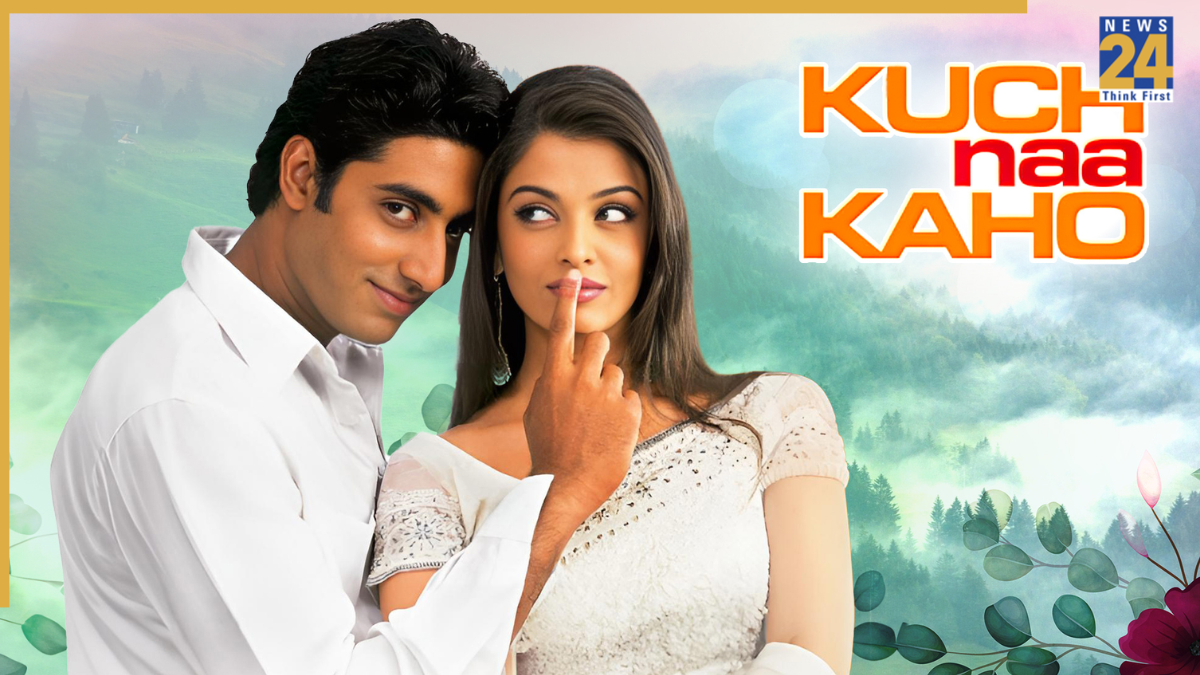
So let’s meet our protagonists, the NRI Raj (Abhishek Bachchan) and the dress designer Namrata (Aishwarya Rai). Like all filmy couples, they clash in a cutely devised scene at an airport where Raj tricks the emotionally gullible Namrata into parting with her plane ticket. So far, so cool.
Cut to Raj’s cousin’s wedding where… and we know the rest, don’t we? Kuch Na Kaho offers the comfort of the familiar in scenes that are devised with utmost integrity. Rohan Sippy seems to have mastered the syntax of smooth storytelling without punctuating every sequence with an exclamation mark.
The sequences building up to a relationship between the two discernibly incompatible protagonists are dotted with roomy romantic representations. If it isn’t Shankar-Ehsaan-Loy’s graceful love duets, then it’s Aadesh Shrivastava’s feelingly done background score inviting us to partake in Raj’s growing fondness for the woman chosen to escort him through a series of matchmaking misadventures.
Admittedly, some of these episodes where Raj uses his ironical humour to wriggle out of marital alliances (“What do they call you when your hair is loose?” he asks a ponytailed wannabe bride named Pony) are stretched out too far. The later light sequences in a boarding school, where the couple with some help from a boisterous Punjabi couple (Jaspal Bhatti and Himani Shivpuri) frolic with the kids, demonstrate an arcadian innocence denied to most moisturizing dreams from Bollywood’s factory of melodrama.
Also Read: Parvati Balagopalan’s ‘Rules (Pyar Ka Superhit Formula)’ Completes 22 Years
The melodrama is mellow, almost a dormant partner, awakened from a state of semi-consciousness when Raj discovers that Namrata is actually a single mother of a growing boy. So what’s the big deal? That’s precisely the point which Rohan Sippy makes through his hero Raj. Not much time or space is wasted in convincing the bigoted samaaj about the unconventional alliance. Instead, the narrative spends quality time with Raj as he builds his relationship with Namrata and her precocious son Adi (Parth Dave).
Refreshingly, the romance and its fallout are freed of heaving humbug. The ingredients of courtship are discreetly deployed. We never feel overpowered by the essential predictability of the central relationship. Rather, we rejoice as the film draws with comforting grace to an inevitable finale.
While showing a disarming effortlessness in handling the cosmopolitan joint-family values (pasta for nashta, so to speak), Rohan Sippy loses his habitual cool in the more ‘filmy’ scenes, such as the one where Raj and Namrata’s husband Sanjeev (Arbaaz Khan) make the same wish with a coin at a temple.
The coin clangs a little hard across the temple steps as the debutant director pants after it in hot pursuit of conventional drama. Such moments are blessedly sparse in the cologned climate of soft shades and supple emotions.
Both Abhishek Bachchan and Aishwarya Rai confer muted shades to their characters. But Aishwarya needs to guard against resorting to her trademark mannerisms (e.g. the nervous giggle to convey girlish glee and the pursed lips for fury) if she intends to grow beyond Sanjay Leela Bhansali. Her clothes sense leaves much to be desired. Her sartorial sense is especially annoying here since she plays a dress designer. Why not the good old reliable sari more often, since she plays a mother?
For once, Abhishek’s distinguished heredity isn’t suppressed. Rohan Sippy allows the young Bachchan to bring in his father’s style, especially in the comic scenes. Check Abhishek out in the sequence where he convinces his uncle Satish Shah that his future son-in-law is gay.
Some of the humour, songs, choreography, and the clumsily staged, shrill, out-of-sync climax at the wedding are reminiscent of Farhan Akhtar’s Dil Chahta Hai. There are some glaring lapses of continuity, especially in the costumes department. On the plus side, V. Manikandan’s cinematography, especially in the sequence where the couple fight on a deserted road in the rain, is stunning.
The film’s flaws don’t conceal its tapestried mood of abundant emotions. No one can dislike Kuch Na Kaho. That’s for sure. But why the incessant promotion of a cola brand at the cost of credibility? Too many Cokes could’ve spoilt this broth.
Also Read: Sudhir Mishra’s ‘Calcutta Mail’ Completes 22 Years