

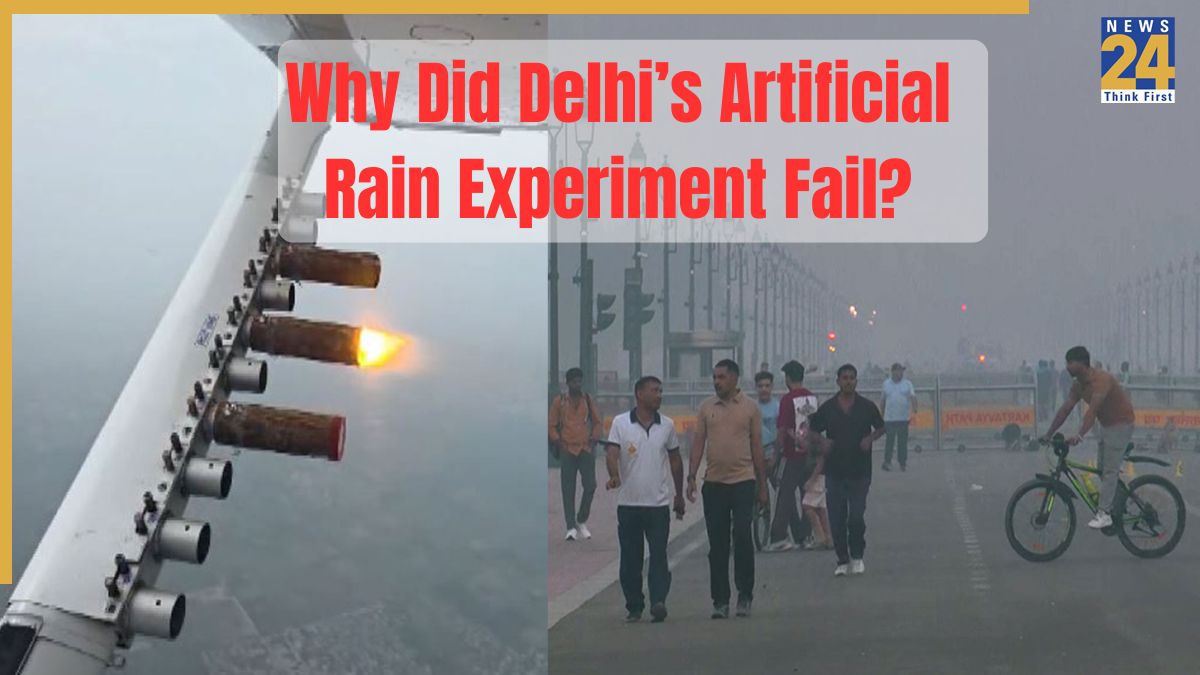


cloud seeding delhi: Delhi’s most boasted cloud seeding process to create artificial rain has been the latest debate among scientists and experts. Why are the attempts to induce rain through cloud seeding “not completely successful?” Were there any flaws that the officials missed during the process? What’s next after this? Will Delhi see another round of cloud seeding trials? Here’s what you should know.
Why didn’t Delhi get the Rain after Cloud Seeding?
cloud seeding delhi: The Cloud seeding experiment in Delhi on Tuesday did not bring the expected rainfall. The possible reason that the experts state for this failure is that the clouds lacked enough moisture during the process. However, scientists from IIT Kanpur, who are working with the Delhi government on the project, said that the trial, though only partly successful, increased their confidence for future attempts.
IIT Kanpur Director Manindra Agarwal said that the first round of cloud seeding on Tuesday did not produce rain because the moisture in the clouds was only about 15-20%, far below the ideal level.
“There hasn’t been any rain so far, so in that sense, it was not completely successful,” he was quoted by NDTV as saying. The team used 14 flares containing a mixture of 20% silver iodide, with the rest made up of rock salt and common salt, to encourage condensation and rainfall.
Agarwal explained that the aircraft flew over areas where clouds were present, but the low humidity made rainfall nearly impossible. Despite this, he said the experiment was valuable because it demonstrated that the team could carry out such operations effectively and safely.
“There have been conflicting reports of the predictions about rain on Tuesday. Some said there will be rain, some said there won’t be. But what our team found was that the cloud cover had very little moisture content. And this could be true about the part we flew over. So we did not expect any rain to occur on Tuesday,” he added.
Cloud-seeding activity planned for today (29 October 2025) put on hold
According to an official statement of IIT Kanpur, the cloud-seeding activity planned for today (29 October 2025) has been put on hold due to insufficient moisture in the clouds. They said that the process is highly dependent on the right atmospheric conditions. In the statement they also said that, while the rainfall could not be triggered yesterday, the trial delivered valuable insights. The reason for the rainfall failure was because that the moisture levels were around 15 to 20%.
Monitoring stations set up across Delhi captured real-time changes in particulate matter and moisture levels. The data shows a measurable reduction of 6 to 10 percent in PM2.5 and PM10 concentrations, indicating that even under limited moisture conditions, cloud seeding can contribute to improved air quality.