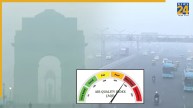

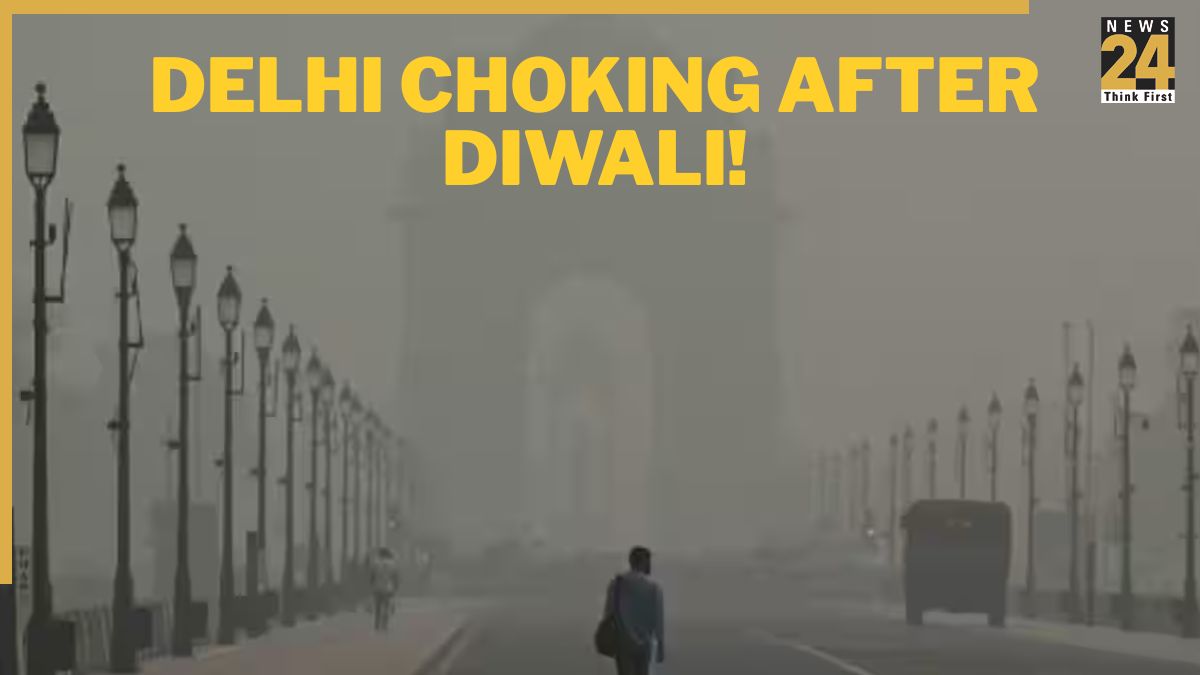


Delh-NCR AQI: Delhi’s air quality remained very poor on Tuesday morning after Diwali. At 5:30 am, the city’s average AQI was 346, with most areas in the red zone. Even though people used ‘green’ firecrackers after the Supreme Court lifted the ban, air quality dropped to the very poor category on Sunday. By 10 pm Monday, 36 of 38 monitoring stations recorded pollution levels in the red zone, showing very poor to severe air quality across Delhi.
Watch Video Here..
#WATCH | Visuals from Akshardham temple as GRAP-2 invoked in Delhi.
---Advertisement---The Air Quality Index (AQI) around Akshardham was recorded at 358, in the 'Very Poor' category, in Delhi this morning as per the Central Pollution Control Board (CPCB). pic.twitter.com/6JxECL9uPe
— ANI (@ANI) October 21, 2025
---Advertisement---
According to Delhi’s Early Warning System, many areas in the city recorded an AQI above 400. The AQI this morning is similar to the level on Diwali evening. Delhi’s 24-hour average AQI, reported daily at 4 pm, stayed in the ‘very poor’ category at 345 on Monday. This data comes from the monitoring stations, according to the Central Pollution Control Board (CPCB). Prolonged exposure to “very poor” air can cause respiratory illness, as per the CPCB. PM 2.5 recorded at 358 and PM 10 at 340 at Anand Vihar station. However, Wazirpur station recorded AQI at 408, falling under the severe category, with major pollutant being PM 2.5.
What is AQI?
The Air Quality Index (AQI) is a tool that helps people understand the level of air pollution in simple terms. It is calculated using eight main pollutants: particulate matter (PM10 and PM2.5), ozone (O3), sulphur dioxide (SO2), nitrogen dioxide (NO2), carbon monoxide (CO), lead (Pb), and ammonia (NH3).
Supreme Court’s Verdict on Green Crackers – Diwali
On October 10, 2025, a bench led by Chief Justice B.R. Gavai and Justice K. Vinod Chandran verbally greenlit a trial relaxation: sale and bursting of only green firecrackers will be allowed for these five Diwali days, but strictly between 8 PM and 10 PM each evening. The new shift from the blanket ban imposed on April 2025. The bench noted, “For the time being, we will allow it during the five days of Diwali on a trial basis…However, we will confine it to certain time limits”.
On October 15, the bench said that the order is temporary. It is meant to see if allowing some controlled use of firecrackers can happen without harming efforts to reduce pollution. The court asked the Central Pollution Control Board (CPCB) and state boards to check air and water quality during this time and submit a report from October 14 to 21 on how fireworks affect Delhi’s air.