

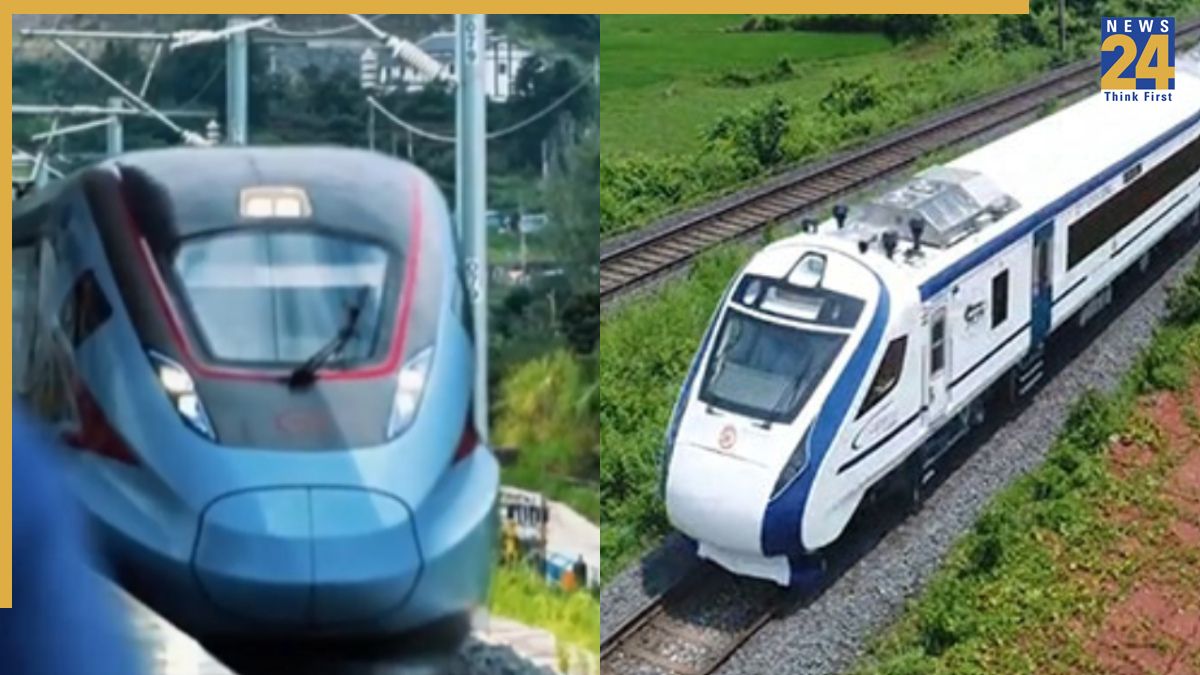


Four new Vande Bharat trains were flagged off by Prime Minister Narendra Modi from Varanasi on November 8. With this, Indian Railways is now operating a total of 164 Vande Bharat Express trains across the country.
The Vande Bharat Express is seen as a major achievement under India’s ‘Make in India’ initiative. However, if we talk about global high-speed railways while comparing China’s vast network and the speed of its trains, there is a significant gap between the two. Let’s understand how much faster our trains need to run on the tracks to compete with China.
The maximum speed of Vande Bharat trains is 180 km per hour, which is much lower in comparison to China’s CRH or Fuxing trains. China’s trains are capable of running at speeds between 350 km per hour and 450 km per hour. On many routes, the current operational speed of Vande Bharat ranges from 110 km per hour to 130 km per hour, while the operational speed of China’s CRH/Fuxing trains is between 250 km per hour and 350 km per hour.
Vande Bharat trains are semi–high-speed trains, and its purpose is to provide better travel experience to the passengers, and to reduce travel time. On the other hand, China aims to use ultra–high-speed trains to make long-distance travel an alternative to air travel.
The newly inaugurated Vande Bharat Express trains will operate on the Banaras-Khajuraho, Lucknow-Saharanpur, Firozpur-Delhi, and Ernakulam-Bengaluru routes. By significantly reducing travel time between major destinations, these trains will enhance regional mobility, promote tourism and support economic activity across the country.