



India is aiming to capture 10 percent of the global green hydrogen demand that is expected to cross 1000 million metric tonnes in another five years.
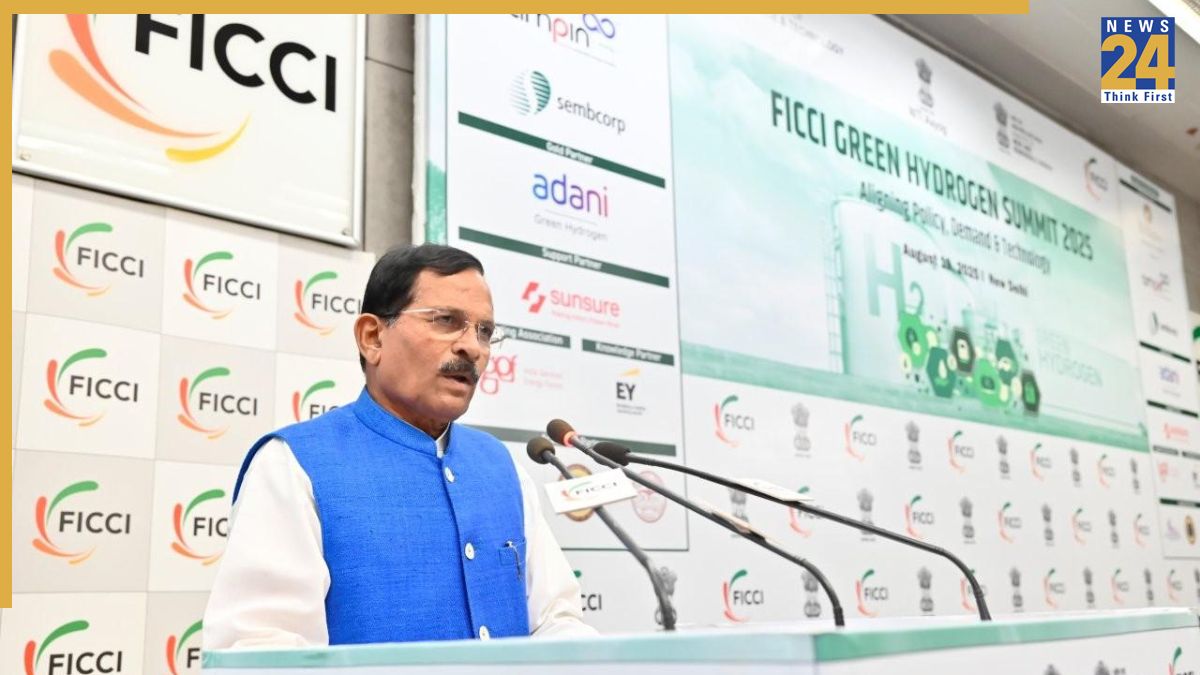
Announcing this at a FICCI Green Hydrogen Summit held here on Tuesday, Union Minister of State for Power and New and Renewable Energy, Shripad Naik said that at present 19 companies were allowed a production capacity of 862,000 tonnes under the National Green Hydrogen Mission.
The government has awarded 3,000 megawatts of electrolyser manufacturing capacity to 15 companies, sparking off a significant industrial development in the sector.
‘We want to make India not only a major producer but also a global hub for green hydrogen export,’ Naik said, outlining the country’s strategy to position itself as a reliable exporter in the rapidly expanding global market.
Highlighting the country’s renewable energy achievements, he said, as in June 2025, cumulative installed renewable energy capacity reached 237 gigawatts, including 119 gigawatts of solar, 52 gigawatts of wind, and 49 gigawatts from large hydro. Combined with 8.78 gigawatts of nuclear power, non-fossil fuel sources now represent more than 50% of total installed power generation capacity.
‘This is a matter of immense pride that we have achieved this key NDC target five years ahead of schedule,’ Naik said, crediting it to the leadership of Prime Minister Narendra Modi. India has set a target of 500 gigawatts of non-fossil fuel-based capacity by 2030, requiring annual capacity additions of approximately 50 gigawatts.
Industry leaders at the summit expressed optimism about recent developments and government support. Rajat Seksaria, Chair, FICCI Green Hydrogen Committee and CEO – Green Hydrogen & Derivatives, Adani New Industries, acknowledged the unprecedented government support, highlighting three key achievements: PLI scheme support for the industry, the world’s first green ammonia auction creating real demand and absorption capacity for Indian developers, and consistent government commitment that provides crucial confidence to the sector requiring long-term investments.
Vipul Tuli, Chair of FICCI’s Renewable Energy CEOs Committee and Chairman, Sembcorp India, revealed that green hydrogen has achieved price competitiveness against blue hydrogen in recent global tenders — a significant milestone for the industry.
‘In one of the global tenders, green has actually come out cheaper than blue. Please understand the implications of that — it’s a very significant development,’ Tuli said, though he cautioned that the industry must focus on building sustainable, long-term commitments rather than simply chasing low prices.
The European Union demonstrated strong support for bilateral cooperation in the sector. Dr Ewa Suwara, Chargé d’affaires of the EU Delegation to India, announced plans for enhanced collaboration following the second India-EU Green Hydrogen Forum held in Rotterdam in May 2025.
‘Both the EU and India are well aware of the potential of green hydrogen in tackling today’s and tomorrow’s energy dilemmas,’ Suwara said, revealing that both sides have agreed to establish a Hydrogen Task Force as a high-level platform for discussing strategies and practical implementation.
Fifteen states have already notified their green hydrogen policies, with several others actively developing frameworks. These states are facilitating land allocation, ensuring water availability, promoting renewable power banking, and incentivising innovation through hydrogen hub development.