


8th Pay Commission: Interest is growing over the official formation and implementation of the 8th Pay Commission, as central government employees and pensioners eagerly await its announcement. They remain uncertain about how to calculate pay hikes and pension increases using the fitment factor. Will the government adopt a completely new formula this time, or continue with the Pay Matrix system from the 7th Pay Commission? And what will happen to the fitment factor, which is key to determining salary hikes? Here, we explain the process and show how you can easily calculate your hike based on your basic pay.
8th Pay Commission: Pay Matrix will continue with the fitment factor
Government sources say that the pay matrix will remain the same as in the 7th Pay Commission. However, a new fitment factor will be applied to increase salaries. The fitment factor plays a key role in determining central government employees’ salaries and pensions. Currently, under the 7th Pay Commission, it stands at 2.57. If the new factor, ranging between 1.92 and 2.86, is adopted, central government pay scales will see a sharp rise.
8th Pay Commission: How the fitment factor works
- Proposed (8th CPC): Basic Pay × 2.86 = New Basic Pay (DA starts at 0%, but merged allowances boost the base)
- Current (7th CPC): Basic Pay × 2.57 = Revised Basic Pay (plus DA, HRA, etc.)
What is the current basic pay of Central government employees?
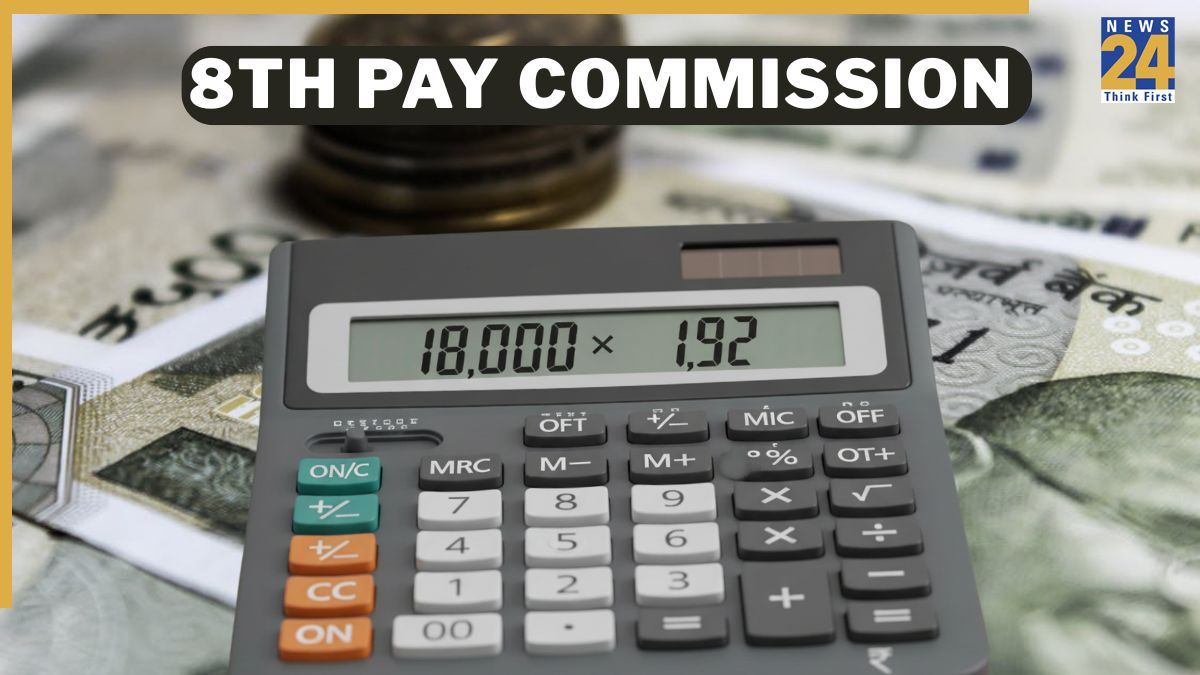
Currently, central government employees receive a basic pay of Rs 18,000 per month. If the proposed fitment factor of 1.92 is implemented, their new basic pay could be: Rs 18,000 × 1.92 = Rs 34,560 per month.
This means the basic pay alone could increase by more than Rs 16,500. With DA (Dearness Allowance), HRA (House Rent Allowance), and other allowances added, the total monthly salary would be much higher.
Salary hike example: Rs 70,000 basic pay could exceed Rs 2 lakh
If your basic salary is Rs 70,000, here’s how the salary will rise.
- New basic pay with 1.92 fitment factor:
- ₹70,000 × 1.92 = ₹1,34,400
- Dearness Allowance (DA) at 55%: ₹1,34,400 × 0.55 = ₹73,920
- House Rent Allowance (HRA) at 27% for metro city: ₹1,34,400 × 0.27 = ₹36,288
- Total salary: ₹1,34,400 + ₹73,920 + ₹36,288 = ₹2,44,608
- Total salary = ₹2,44,608
By using the same formula, you can calculate the pay rise according to the fitment factor.
Expected pay revision under the 8th Pay Commission
| Fitment Factor | Minimum Basic Salary (Rs) | Minimum Basic Pension (Rs) |
|---|---|---|
| 1.92 | 34,560 | 17,280 |
| 2 | 36,000 | 18,000 |
| 2.08 | 37,440 | 18,720 |
| 2.86 | 51,480 | 25,740 |